

September 18, 2026
Can you use a bounce house indoors?
Yes, in a room tall enough for it. Our castles stand 11 to 17 feet, so a gym or church hall can work and a basement can't. How to measure before you book.
Yes, a bounce house can go indoors, as long as the room has enough clear height above it. Our castles stand 11, 14 and 17 feet tall, so a school gym, church hall or rec center can work, while a basement or a home garage can’t. Measure the ceiling at its lowest point first.
Somewhere around the first October cold snap, parents stop asking whether it will fit in the yard and start asking whether they could do this inside. The answer comes down to one number you can get this afternoon with a tape measure, and to which rooms you can book.
How tall is a bounce house?
Ours run from 11 to 17 feet. Here are all three, with the numbers that matter for an indoor room:
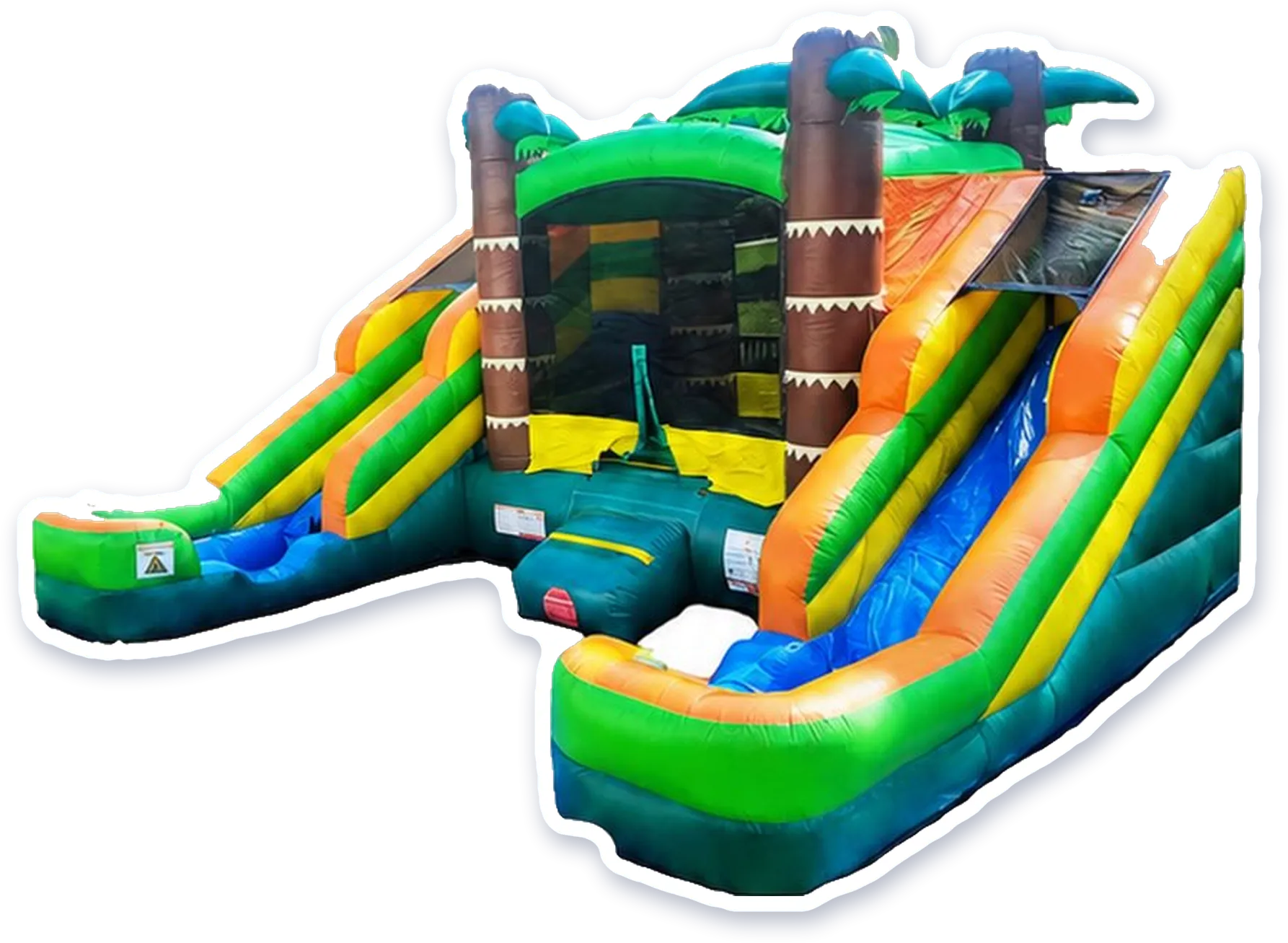
- Castle with Double Water Slide: 11 feet tall on a 16 by 15 foot footprint, 1,000 pound weight limit, $300 for the day. The shortest, and the one to ask about for a church hall or a clubhouse with a high ceiling. Indoors it runs dry, which it’s built to do.
- Classic Castle: 14 feet tall on 13 by 13 feet, 800 pound weight limit, $100 for the day. Needs a room that clears 14 feet with real room to spare, which usually means a gym.
- Castle with Slide: 17 feet tall on 15 by 16 feet, 1,000 pound weight limit, $200 for the day. This one belongs in a full-size gym with a high, clear ceiling; most halls don’t have the height.
Floor space is the second check. Take the footprint above, add some slack on every side for the blower and the anchors, and keep the area in front of the entrance clear of walls, tables, stacked chairs and anything with a corner on it. Kids come off a castle fast.
How much ceiling height do you need?
More than the castle’s height, measured to the lowest thing hanging from the ceiling rather than the ceiling itself. Gyms have basketball hoops folded up near the roof, light fixtures on drops, heaters and ductwork, and church halls often have beams and ceiling fans. A room that’s 18 feet at the peak and 12 under the lights is a 12 foot room for our purposes.
Then leave real headroom above the castle, not an inch or two. Published advice from inflatable manufacturers runs from about 3 feet of clearance above the top of the unit up to 6. Even the low end of that range changes the picture: Castle with Double Water Slide wants a room of roughly 14 clear feet, Classic Castle roughly 17, and Castle with Slide roughly 20. Treat those as a starting point for a conversation with us, since we’ll look at your actual room before saying yes. Turn any ceiling fans off for the day either way.
Still unsure after measuring? Send us the ceiling height, the room size and a photo, and we’ll tell you before you book.
Can you put a bounce house in a basement or garage?
Not one of ours. The shortest castle we have is 11 feet tall, and a typical basement ceiling is 8 feet, so none of the three fits, and none fits a normal home garage either. Smaller inflatables made for low ceilings do exist, but we don’t carry one.
If the house is your only indoor option, a winter party with a piñata works fine in a basement, and the castle can wait for a spring date in the yard. What your yard needs before we bring the castle covers that side of it.
Which Colorado venues have the ceiling for it?
Around Parker, Castle Rock and the rest of the south metro, the places to look are school gyms, church fellowship halls with a high ceiling, rec center gyms and the kind of clubhouse an HOA rents out. The building type only tells you where to start. A hall that measures 12 feet under its lights rules out everything but the 11 foot castle, and with headroom counted it may rule that one out too.
Most hall and gym bookings go through one person, and they’ll have a short list of their own questions. Having yours ready saves a round of emails:
- What’s the clear ceiling height at the lowest point, under the lights and hoops?
- How big is the open floor, and can the tables and chairs be moved?
- Where are the outlets, and which ones are on separate circuits?
- Does the floor need anything under equipment?
- Can the vendor get in before the party starts, and how far is it from the loading door?
- Do you need a certificate of insurance?
That last one comes up a lot with churches, schools and clubhouses. We carry $25,000 per person, $50,000 per accident and $100,000 aggregate in liability cover, and we keep the certificate on the phone to show whenever it’s asked for. Ask for it ahead of time so it isn’t a scramble the morning of. There’s more on this on our safety page.
Is it safe to run a bounce house inside?
It is when the room fits and the usual rules hold. Everything that applies in a yard applies in a gym, and a hard floor around the castle makes a couple of them matter more:
- An adult watches the whole time the castle is in use, from close enough to step in, not from across the room.
- Shoes off, and no food, drinks or gum on the castle.
- Keep kids of similar size on together. A toddler bouncing next to a ten-year-old is the situation to avoid.
- Stay under the weight limit: 800 pounds total on Classic Castle and 1,000 pounds on the two larger castles. That’s the combined weight of everyone on it at once. We don’t publish a headcount because kids weigh different amounts, so the weight limit is the number to go by.
- Keep the floor in front of the entrance open, so kids climbing off land on floor and not on a chair leg.
Can you put a bounce house on concrete or a gym floor?
Yes, as long as the floor is flat. We anchor every castle with four to six sandbags, set before anyone climbs on, and we don’t stake, so nothing gets driven into a gym floor or a tiled hall. What we need from a floor is the same thing we need from a yard: level ground. Indoors that’s rarely a problem.
Sealed concrete, tile, vinyl and a gym floor all work if they’re level. Sweep the spot before we arrive, because grit under a castle scratches the floor and wears the vinyl. Carpet is harder to say yes to without seeing it, so mention it when you ask.
Venues with a finished gym floor sometimes have their own rules about what can sit on it, including whether they want something laid down underneath. Ask the facility manager what they require under equipment, then tell us, and we’ll tell you whether we can meet it.
What does the blower need indoors?
Every castle runs off a blower that stays on the whole time the castle is up. Blowers are loud and need a clear intake, so plan a spot for it out of the path people walk and away from where the adults will be talking.
Tell us where the outlets are when you confirm the date, the same way you would for a yard. We haven’t published how much power each blower draws, so ask us before you book if you’re working with an older building. A few things are good practice anywhere:
- Plug the blower into its own circuit if the venue can tell you which outlets share one. Coffee urns, slow cookers and space heaters all pull power at the moment a party gets going.
- If a cord has to cross a walkway, tape it flat. A cord in a gym doorway is a tripping hazard for every adult carrying a plate.
- Ask us whether we’re bringing the cord or you should have one, so nobody arrives assuming the other person has it.
Getting it through the door
In a yard the question is gate width, which is why our booking form asks for it. Indoors it’s the doors, the hallway and any stairs between where we park and the room. A castle comes in rolled up with the blower alongside, so tell us about steps, narrow corridors and whether there’s a ground-floor entrance near the room. An icy walk from the lot is worth a mention too.
Setup takes 30 to 45 minutes from parked to first jump, and about the same to pack down, so book the room for that much time on either side of the party.
What temperature is too cold for a bounce house?
The only temperature rule we run by is for water: Castle with Double Water Slide doesn’t run wet below 50°F, so from fall onward it goes up dry. Inside a heated hall the weather outside doesn’t reach the castle at all.
It does reach the drive. If a storm rolls in close to the date and the roads turn bad, tell us early and we’ll work out a new time with you so you aren’t left stuck. Build a little give into the venue booking if you can, because a hall that can shift you by an hour is easier to work with than one that locks the room to the minute.
Halls and clubhouses fill up with holiday parties in December, so if you have a date in mind, lock the room first and then send us the date.
Booking an indoor date
Day rates are $100 for Classic Castle, $200 for Castle with Slide and $300 for Castle with Double Water Slide, delivered, set up and collected, all on the cost page. We deliver to Parker, Denver, Aurora, Castle Rock, Littleton and Centennial at no extra charge, and further out for a distance-based fee. Our delivery page has the details.
We’re a small local outfit, and we’d sooner check a room than guess at it. Send us the date with the venue’s name, the ceiling height at its lowest point, the room size and where the outlets are. Say it’s indoors in the notes, and we’ll tell you which castle fits, or whether none of them do, before you commit to anything.
Check availability
Tell us the date and what you're planning. We reply with what is open.
Check availability